
For the last fifteen years, the digital marketing playbook was universally agreed upon: Write an incredible 50-page industry report, save it as a PDF, build a high-converting landing page, and force visitors to trade their email address to read it. It was the golden era of the "Lead Magnet."
As of 2026, that playbook is actively destroying brand visibility.
We have entered the era of AI-First Search. Users are bypassing traditional blue links and asking generative AI models to synthesize data, compare products, and solve problems in real-time. These models—powered by Retrieval-Augmented Generation (RAG)—scour the live internet to formulate their answers.
There is only one problem: AI bots do not have email addresses, and they cannot fill out lead forms.
When an AI crawler hits a gated landing page, it reads the headline, sees a form, and bounces. The 50 pages of proprietary data, original research, and expert insights locked inside your PDF are entirely invisible to the machine. As a result, when a user asks the AI a question that your report answers flawlessly, your competitor—who published their data as a public HTML article—gets cited as the authoritative source. Your brand is erased from the narrative.
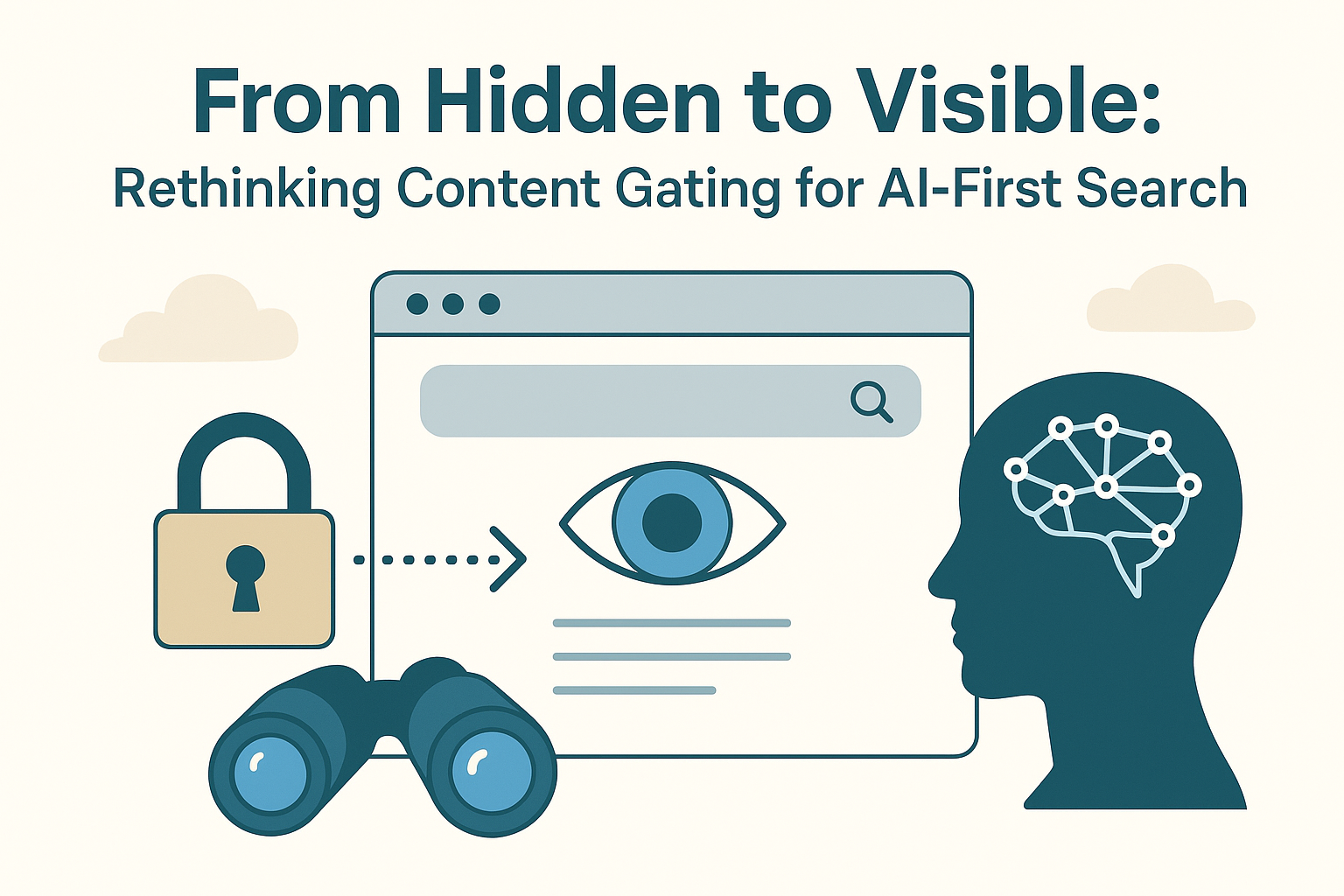
To survive in 2026, brands must transition from "Hidden" to "Visible." This requires a radical rethinking of content gating, lead generation, and how we track attribution.
The Mechanics of AI-First Search
To understand why gating is failing, you must understand how Answer Engines work. When a user asks an AI model a question (e.g., "What are the latest conversion rate benchmarks for e-commerce?"), the AI does not magically "know" the answer. It executes a rapid, multi-stage process.
First, it checks its persistent, pre-trained memory. If the data isn't there, it initiates a live retrieval query (RAG). It scrapes the top available live URLs related to the query, reads the raw text, extracts the factual data, and synthesizes a response, appending citations to the sources it used.
If your conversion rate report is a downloadable PDF behind a form, the AI crawler physically cannot access the data. It cannot click "Download Now," input "bot@openai.com," and parse a localized file. It simply moves on to the next website that has the data available in plain, semantic HTML.
In Generative Engine Optimization (GEO), the most valuable currency is "Entity Status." An AI needs to recognize your brand as an authoritative entity in a specific niche.
If all your best thought leadership is hidden behind a paywall or a gate, the AI has no semantic proof of your expertise. It associates your domain only with the thin marketing copy on your landing pages. Over time, your competitor, who is giving away their knowledge publicly, becomes the AI's default "Source of Truth," compounding their organic visibility while yours shrinks.
Strategic Ungating: The 2026 Framework
The solution is not to stop generating leads. The solution is Strategic Ungating. You must separate your content into two categories: Knowledge (which trains the AI) and Utility (which captures the human lead).
1. Ungate the Knowledge (Train the Machine)
Original research, proprietary data, methodology, and thought leadership must be public. Instead of a PDF, publish your 50-page industry report as a massive, beautifully formatted HTML "Pillar Page" on your website.
Use semantic tagging (,
,) and inject FAQPage and Article JSON-LD schemas. Make the data as easy for an AI bot to parse as possible. When the AI is searching for statistics to answer a user's prompt, it will scrape your page, extract your data, and cite your brand. You have successfully inserted yourself into the AI Knowledge Graph.
2. Gate the Utility (Capture the Human)
If the knowledge is free, what do people trade their email for? Execution.
Humans will gladly read a 5,000-word public guide on "How to run a Facebook Ad campaign." But they will trade their email address for the exact plug-and-play spreadsheet template used to track that campaign's ROI. You ungate the strategy, but you gate the template. You ungate the analysis, but you gate the consultation. You ungate the benchmarks, but you gate the interactive calculator.
The Analytics Problem (And How Trimrly Solves It)
For years, marketing directors pushed back against ungating content for one specific reason: Attribution.
A form-fill was a definitive tracking event. When a user submitted their email, the marketing team knew exactly who they were, what campaign brought them there, and that they were a qualified lead. If you ungate the content, you lose that definitive friction point. How do you track intent if anyone can read the page anonymously?
You replace form friction with link analytics.
Instead of tracking who downloaded a file, you track who clicked to view the public asset, and what they did afterward. This is where a professional link management infrastructure like Trimrly becomes the backbone of modern AI-first marketing.
Tracking Intent without Forms: Instead of linking to a PDF, you share a Trimrly short link (e.g., yourbrand.com/2026-report) across your social channels, email blasts, and ads. Because Trimrly offers permanent, deep analytics on its free tier, you instantly capture the click volume, geographic location, device type, and referral source of every reader. You gather the metadata without asking the user to type a single word.The Pixel Retargeting Engine: Trimrly allows you to attach tracking pixels (Meta, Google Tag Manager) to your short links. When a user clicks to read your ungated public report, they are seamlessly added to your retargeting audience. You didn't capture their email, but you captured their digital footprint, allowing you to serve them ads for your "Gated Utility" later.Bio Pages as Content Hubs: Instead of one landing page with one form, creators use Trimrly Bio Pages. You place your public HTML report as the top button. Below it, you embed a Trimrly Newsletter Widget (soft gating) and a Calendly Widget (utility gating). You give the user the choice to consume the public data or engage directly.
Gated vs. Ungated (AI-First) SEO: The Comparison
The shift requires a completely different technical architecture. Here is exactly how the traditional 2020 model compares to the 2026 AI-First model.
Metric / Feature | Traditional Gated Model (PDF) | AI-First Ungated Model (HTML) |
|---|---|---|
AI Crawler Accessibility | Blocked by Form | 100% Crawlable |
Entity Citation Potential | Zero | High (Trains LLMs) |
User Friction | High (Requires Email) | Zero (Instant Access) |
Attribution Method | Form Submit / CRM | Trimrly Link Analytics / Pixels |
Lead Quality | Low (Fake emails common) | High (Utility-driven intent) |
Mobile Experience | Poor (Pinch-to-zoom PDF) | Responsive HTML / Bio Pages |