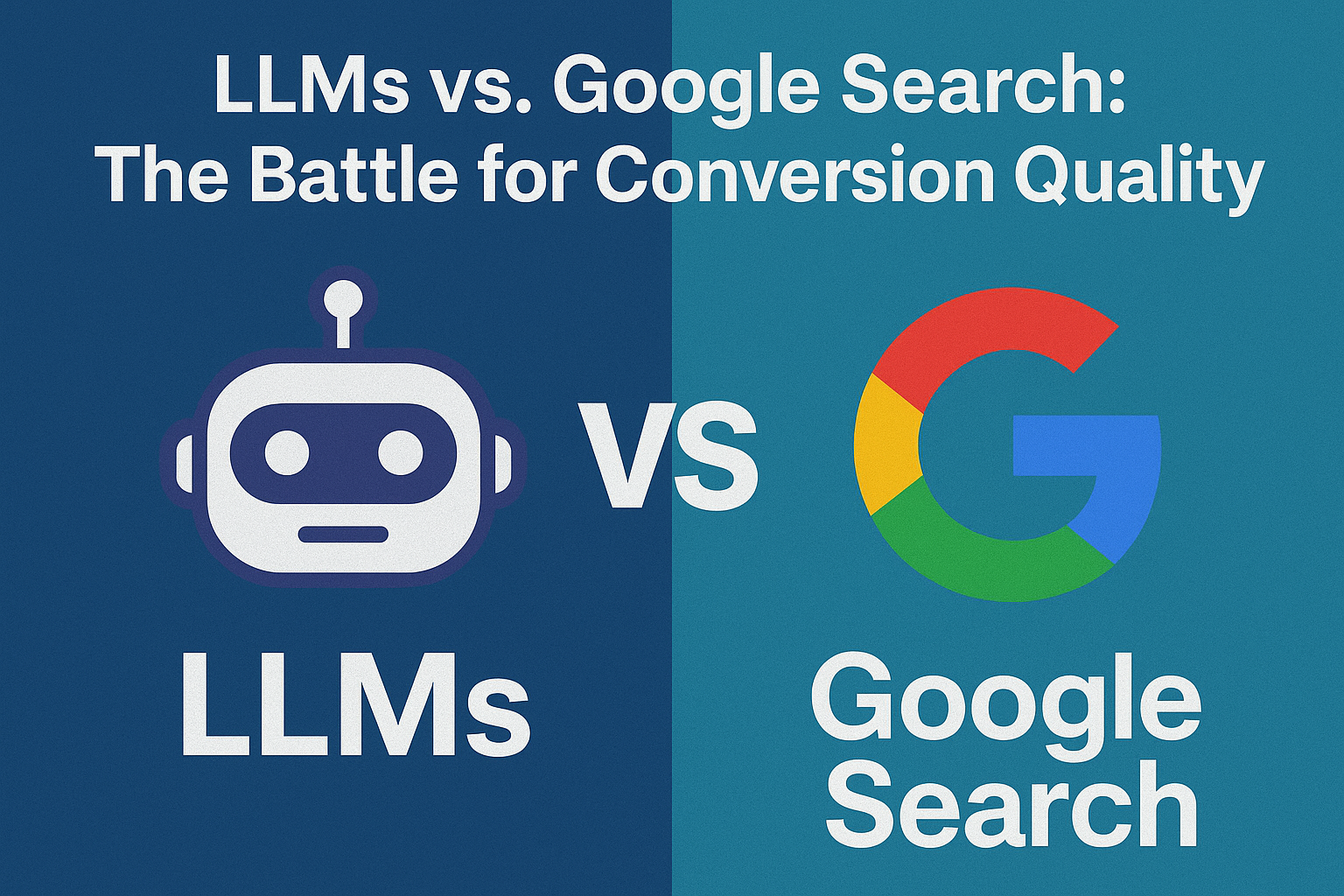
The data on LLM conversion quality is genuinely confusing — not because the research is bad, but because different studies are measuring different things at different stages of an evolving market. One study finds ChatGPT converts at 11.4%. Another finds it underperforms every traditional channel except paid social. Both are peer-reviewed or published by credible agencies, and both are correct.
The disagreement is not a sign that the research is unreliable. It is a sign that LLM referral traffic is still emerging, contextually dependent, and measured differently across studies with different methodologies, time periods, and industry compositions.
This article surveys every major study available as of May 2026, explains where they agree and why they appear to conflict, and draws practical conclusions for businesses trying to understand whether and how to invest in AI search visibility.
The Headline Numbers Side by Side
Before explaining the nuance, here is the clearest version of the core tension. These two metrics are simultaneously true.
The two statements are not contradictory. A channel can have a higher per-click conversion rate and still generate far less total revenue, if the volume difference is large enough. A 31% higher conversion rate does not compensate for 70 times less traffic. That is the honest summary of where LLM referral traffic stands in 2026.
Every Major Study — What They Found and Why They Differ
Five credible studies published between August 2024 and February 2026 have examined LLM conversion quality versus traditional search. They use different methodologies, industry mixes, and time windows — which explains why their headline numbers vary significantly.
ChatGPT converted at 1.81% vs 1.39% for non-branded organic — 31% higher. Revenue per session was 10.3% higher for ChatGPT ($3.65 vs $3.30). But average order value was lower ($204 vs $238), so net revenue per session advantage was modest. Non-branded organic was 70× larger overall, narrowing to 47× in Q4 2025 after ChatGPT shopping carousels launched in April.
Estimated ChatGPT ecommerce conversion rate at 11.4%, compared with 5.3% for organic search. The 2.15× conversion advantage is the highest headline figure of any study — but Similarweb acknowledges this is an estimate and methodology details are limited. The report also confirms AI referral traffic is still a small share of total ecommerce volume.
Found that ChatGPT referral traffic (oLLM) underperformed every traditional channel except paid social across conversion rate, average order value, and revenue per session. Lower bounce rates suggested visitors found relevant content, but they completed fewer purchases. The study's large scale (973 sites, $20B revenue) gives it significant statistical weight — but the industry mix skewed toward commodity ecommerce where AI referrals may not yet be mature.
ChatGPT converted at 15.9% versus 1.76% for organic search — a 9× difference. Visitors from ChatGPT viewed an average of 2.3 pages per session versus 1.2 for organic. Perplexity converted at 10.5%, Claude at 5%, Gemini at 3%. Seer attributes the dramatic difference to B2B buyers using ChatGPT for in-depth research before engaging with a vendor — the pre-qualified buyer effect is strongest in complex, high-consideration purchases.
Industry conversion rates from ChatGPT ranged from 1.4% (engineering) to 7.0% (hotels and resorts). Found B2B sector industries show greater conversion improvement from ChatGPT than B2C. The report attributes ChatGPT's conversion advantages to its conversational context — users who arrive from ChatGPT have often already resolved their basic questions and are at a more advanced stage of the purchase journey than a typical search visitor.
Why the Studies Contradict Each Other — The Resolution
The Hamburg/Frankfurt working paper and the Visibility Labs study appear to reach opposite conclusions. Both are credible. The contradiction resolves when you examine four variables: industry, product complexity, measurement methodology, and timing.
| Variable | Higher LLM CVR finding | Lower LLM CVR finding |
|---|---|---|
| Industry / product type | B2B software, hotels, complex products — high consideration, research-intensive | Commodity ecommerce, impulse purchases, price-driven categories |
| Dataset composition | 94 seven- and eight-figure ecommerce brands (Visibility Labs); B2B software client (Seer) | 973 sites of varied scale including many smaller ecommerce operations |
| Timing | Post-April 2025 (after ChatGPT shopping carousels launched) — traffic matured | Aug 2024 – Jul 2025 — includes pre-carousel period when AI traffic was immature |
| Attribution methodology | GA4 direct referral tracking — clean LLM sessions | Broader dataset with mixed attribution signals and different GA4 setups |
| The dark funnel problem | Visibility Labs explicitly notes ChatGPT-influenced sales often show as branded search — meaning true LLM attribution is undercounted | Studies may attribute sales to Google branded search that were originally influenced by ChatGPT research |
Both Visibility Labs and Seer Interactive flag the same hidden problem: many users get product recommendations from ChatGPT, then search for the brand or product on Google before purchasing. Those conversions are attributed to branded organic search — not to ChatGPT. This means every study that measures GA4 referral data is undercounting ChatGPT's influence. The true share of revenue originating in a ChatGPT conversation is higher than any current study shows. Post-purchase surveys are currently the only reliable way to capture this dark funnel data.
Why LLM Traffic Converts Better: Intent Compression
The mechanism that explains higher LLM conversion rates is consistent across every study that finds a positive effect. Visibility Labs named it "intent compression." Seer Interactive described it as "in-depth research before engagement." First Page Sage called it "conversational context."
They are all describing the same phenomenon. A user who searches on Google for "best project management software" is typically near the beginning of their consideration journey. They may visit four to eight websites, compare features, read reviews, and return over multiple days before converting. A user who asks ChatGPT "I manage a team of 12 engineers, we use Jira but it's too complex, what should we switch to?" has already conducted their discovery phase inside ChatGPT. By the time they click through to a website, they are pre-qualified. The research is done. The journey is compressed.
Google Discovery Phase
User searches a broad term. Lands on a category page or list post. Learns what options exist. Begins comparison. May return multiple times over days or weeks before converting. Intent evolves as they research.
Visitor may be weeks from purchase
ChatGPT Discovery Phase
User describes their specific situation to ChatGPT. ChatGPT asks follow-up questions, narrows recommendations, explains trade-offs. User arrives at a shortlist — often one or two vendors — before clicking any external link.
Visitor may be minutes from purchase
What This Means for Pages per Session
Seer Interactive found ChatGPT visitors viewed 2.3 pages per session versus 1.2 for organic. High-intent visitors browse more deeply when they reach a site — confirming their pre-formed choice. Organic visitors bounce more quickly when landing on a page that does not immediately match their intent.
2.3× more pages per session
Lower AOV Explained
Visibility Labs found ChatGPT visitors converted more often but at a lower average order value ($204 vs $238). ChatGPT may be particularly strong at recommending mid-tier products that clearly match a user's stated needs — not necessarily the premium option a well-optimised SEO page would upsell toward.
More conversions, lower ticket size
Conversion Rates by LLM Platform — Not Just ChatGPT
Seer Interactive's B2B software analysis is the most granular platform-level breakdown available. The data covers a single client context but reveals meaningful platform-to-platform differences.
What the Data Looks Like for a Real Business: Intent Compression in Practice
The Moment They Realised ChatGPT Traffic Was Different — Not Just More
A project management SaaS company noticed an unusual pattern in their GA4 data in Q3 2025. Sessions referred from ChatGPT had a dramatically higher trial signup rate than organic search sessions — 12.4% versus 2.1%. But there were very few of them: 847 ChatGPT sessions compared to 180,000 organic sessions in the same quarter.
On investigation, they found that ChatGPT was specifically recommending their product to users who described complex team management scenarios — use cases where their product had a genuine structural advantage. The ChatGPT visitors who arrived had already read an AI-generated explanation of why this product suited their situation. They were not browsing; they were confirming.
The organic search visitors, by contrast, arrived through keyword traffic representing the full awareness-to-decision funnel. Most were early-stage. The comparison between the two conversion rates was comparing different populations, not different quality of the same population.
The company's response was practical. They ran post-purchase surveys, which revealed that 22% of their organic-attributed trial signups had been influenced by an LLM conversation before they searched on Google. They began investing in content specifically designed for LLM citation — detailed comparison guides, specific use-case pages, and an FAQ structured around the exact questions buyers ask ChatGPT during vendor evaluation.
What the Conversion Data Actually Means for Your Marketing Strategy in 2026
The data does not suggest abandoning traditional SEO or reallocating significant budget away from organic search. Non-branded organic traffic is still 47 times larger, generates the overwhelming majority of ecommerce revenue, and has a cost structure that most businesses have spent years optimising.
What the data does suggest is a parallel investment — not a substitution — in AI search visibility, specifically targeted toward the use cases where LLM conversion advantages are strongest.
| Context | LLM visibility priority | Google organic priority |
|---|---|---|
| B2B SaaS / complex software | High — Buyers use LLMs for vendor research; intent compression is strongest here | High — Still primary volume driver for awareness-stage traffic |
| B2C commodity ecommerce | Low–Medium — Hamburg/Frankfurt data shows underperformance; LLM shoppers may be price-comparing across many options | Very high — Volume advantage is overwhelming at this scale |
| Hospitality / travel | High — First Page Sage shows 7.0% ChatGPT CVR for hotels; destination research is an LLM-native use case | High — Google Hotels and organic search remain dominant volume channels |
| Professional services | High — "Which accountant / lawyer / agency should I use?" is increasingly an LLM query type | High — Local SEO and organic rankings remain essential for discovery |
| Informational / media | Low — LLMs answer directly, reducing clickthrough to publishers; Google AI Overviews have the same effect | High — Google organic still drives majority of publisher traffic |
Know Where Your Conversions Are Actually Coming From
If ChatGPT is sending high-intent visitors to your site, you need to see it. Trimrly short links with unique aliases per channel give you click-level attribution that GA4 referral data misses — before the session starts, across every channel.
"ChatGPT sends fewer visitors. Those visitors arrive having already decided to buy. Google sends vastly more visitors at every stage of the funnel. The smart answer is not to choose between them."
Frequently Asked Questions
Multiple studies find that ChatGPT referral traffic converts at a higher rate per session than non-branded Google organic traffic — Similarweb estimates 11.4% versus 5.3%, and Visibility Labs found a 31% higher conversion rate across 94 ecommerce sites. However, a large-scale study of 973 ecommerce sites by researchers from the University of Hamburg and Frankfurt School found ChatGPT traffic underperforming traditional channels. The contradiction resolves by industry context: high-consideration B2B and complex product categories show the strongest LLM conversion advantages, while commodity ecommerce shows weaker results. In all cases, ChatGPT's traffic volume is 47–70 times smaller than organic search.
Intent compression describes the process by which LLM users resolve their discovery and comparison phases inside the conversation before clicking any external link. A Google searcher arrives at your website at the beginning of their consideration journey. A ChatGPT referral often arrives having already asked the AI to compare vendors, explained their specific situation, received a recommendation, and decided to verify that recommendation. By the time they click, they are pre-qualified. Visibility Labs attributes ChatGPT's higher conversion rates specifically to this mechanism — users refine their product needs within ChatGPT, leading to higher purchase likelihood upon reaching a product page.
The data does not support replacing traditional SEO with GEO. Non-branded organic traffic from Google is still 47 to 70 times larger in volume than ChatGPT traffic and generates the overwhelming majority of ecommerce and B2B revenue. The correct posture is parallel investment — maintaining and optimising for organic search while beginning to build AI search visibility through in-depth guides, FAQ content, third-party review presence, and earned media. The two channels are increasingly complementary: content that performs well in organic search tends to get cited more often in LLM responses.
The Hamburg/Frankfurt study — which found ChatGPT underperforming traditional channels across 973 ecommerce sites and $20 billion in revenue — used a dataset that included the pre-April 2025 period when ChatGPT had no shopping carousels and AI referral traffic was immature. The dataset also covered a wide range of site sizes and categories, including commodity ecommerce where intent compression benefits are weakest. Studies conducted entirely within the post-April 2025 period, focused on seven- and eight-figure brands or B2B contexts, consistently show ChatGPT outperforming non-branded organic. The takeaway is that the LLM conversion advantage is real but context-dependent, not universal.
GA4 captures direct ChatGPT referrals when users click links within ChatGPT to visit your site — these appear as referral traffic from chat.openai.com or chatgpt.com. However, Visibility Labs and multiple other researchers note that many ChatGPT-influenced purchases happen after the user leaves ChatGPT and searches the brand or product on Google — those conversions are attributed to branded organic search in GA4, not to ChatGPT. The most reliable supplementary method is a post-purchase survey on the checkout confirmation page asking customers how they first heard about you. This dark funnel data typically reveals LLM influence is higher than GA4 referral data suggests.