A couple drives through a neighbourhood on a Sunday afternoon. They slow down in front of a house for sale. The price is right. The kerb appeal is exactly what they described. The husband googles the address while the wife photographs the sign. The Zillow page that comes up has outdated information. The agent's phone number goes to voicemail. By the time they get home, the emotion has cooled. They forget to follow up. The agent never knew they stopped.
That scenario plays out thousands of times a day across every real estate market. 85% of buyers drive by a property before contacting an agent. They are not a cold prospect at that moment — they are as warm as they will ever be, sitting directly in front of the property, emotionally engaged, phone already in hand. The failure is not interest. The failure is friction.
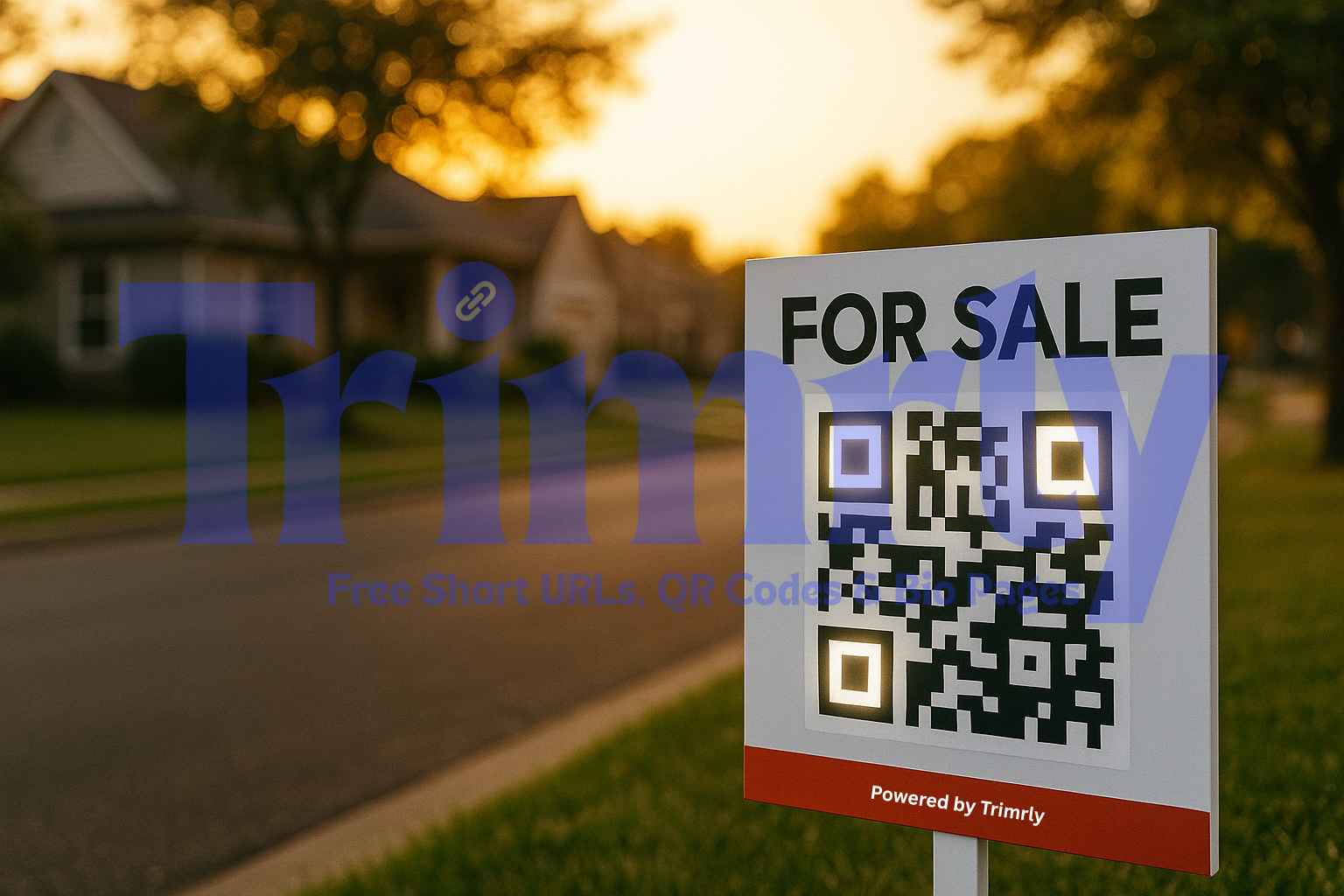
A QR code on the yard sign eliminates that friction completely. The buyer scans from the car window. The full listing opens: 40 photos, the floor plan, the virtual tour, the price, the open house schedule, and a one-tap contact link to the agent. The entire buyer journey that used to require a phone call, a website search, and a follow-up email now happens in the forty-five seconds the buyer is parked outside the property.
According to the National Association of Realtors' 2025 Technology Survey, 67% of buyers under 45 expect to access full property details via their smartphone before ever speaking to an agent. QR codes on property signage are not a novelty. They are the infrastructure that matches what buyers already expect.
The Problem Every Yard Sign Has in 2026
The traditional yard sign has two pieces of information: "For Sale" and a phone number. That model was designed for a world where buyers had no alternative to calling. In 2026, 100% of buyers use the internet during their home search process, and more than two-thirds search on smartphones. A buyer who sees a yard sign and wants more information has their research tool in their pocket. The question is whether your sign gives them what they need instantly — or makes them work for it.
Making them work for it is fatal to the lead. By the time the buyer gets home, opens a browser, searches for the address, finds the listing, and navigates to a contact form, the emotional energy of standing in front of the property is gone. They have visited four other listings in the same window. Your property is now one of many they are vaguely thinking about rather than the one they were actively excited about.
Call Agent: 555-0192
Lost lead — friction kills intent
⬛ Scan for photos, price & tour
Lead captured — zero friction
The QR-Enabled Buyer Journey: From Drive-By to Showing
When a QR code on a yard sign is set up correctly, the buyer journey compresses from days to seconds. Here is what each step looks like when friction is removed.
Analytics on real estate QR scans consistently show peak engagement between 10 AM and 2 PM on weekdays — the window when buyers take a longer lunch, work remotely with flexibility, or drive neighbourhoods on personal time. Knowing your peak scan window is not just analytically interesting — it tells you when to be available for follow-up calls. A showing request that comes in at 11:30 AM on a Tuesday and gets a response within 15 minutes converts at a dramatically higher rate than one that gets a reply the following morning.
Every Real Estate QR Code Use Case — and What Each One Links To
The yard sign is the highest-profile placement. But QR codes handle the full lifecycle of a real estate transaction — from the first drive-by to the post-closing agent review request. Here is the complete map.
Yard Sign
The primary lead capture touchpoint. Links to the full listing page: photos, price, virtual tour, floor plan, open house schedule, and agent contact. One dynamic Trimrly link per listing — update when the listing status changes without replacing the sign.
Primary lead capture
Listing Flyer
A printed flyer in a brochure box or handed at an open house. QR code links to the digital version of the same flyer — with additional photos, a video walkthrough, and a contact form the paper flyer cannot contain. Tracks engagement per distribution point with unique aliases.
Enriches the paper flyer
Open House Check-In
Replace the paper sign-in sheet with a QR code that opens a short digital form: name, email, phone, and whether they are pre-approved. Captures more complete information than most pen-and-paper forms and delivers leads directly to your CRM. Open houses using QR codes for check-ins collect 50% more attendee information than paper-based systems.
50% more lead data
Virtual Tour Access
A QR code printed on any material that links directly to a Matterport 3D tour, a video walkthrough, or a drone footage reel. Particularly powerful for out-of-state buyers and investors who cannot visit in person. One agent sold an $850,000 property to an out-of-state buyer who never physically visited — the QR virtual tour gave them confidence to make an offer.
Out-of-state buyers
Direct Mail and Postcards
A just-listed, just-sold, or market update postcard with a QR code pointing to the full listing, a home value estimator, or a free market report. Each postcard campaign uses a unique Trimrly alias so scan rates are tracked per neighbourhood per campaign. Postcards with QR codes generate significantly more engagement than those without.
Track per campaign
Business Card
A QR code on the back of every business card links to your agent profile page: active listings, recent sales, client testimonials, and a booking link for a free consultation. Every card handed out at a networking event, an open house, or a chance encounter is a traceable, updatable digital introduction.
Always-on digital profile
Neighbourhood Sales Flyer
Mailed or door-dropped to surrounding properties after a sale: "Your neighbour just sold. Find out what your home is worth." QR code links to a home value estimator landing page. This is the seller lead generation strategy with the highest conversion rate in the entire real estate QR toolkit — 13.6% scan-to-lead in a documented case study.
Highest seller lead conversion
Property Brochure Box
When the brochure box is empty — which it frequently is — the QR code on the box itself becomes the fallback. A sticker on the box: "Out of flyers? Scan for the full listing." The dynamic Trimrly link means you can update the destination to a new listing or your agent page when the property sells, without reprinting the sticker.
Never runs out
The Seller Lead Strategy Most Agents Are Missing: Home Value Estimator QR
Every real estate QR code strategy focuses on buyer leads — the person driving past the for-sale sign. The seller lead strategy is less discussed and dramatically more valuable per lead.
The mechanism is straightforward. After closing on a property, mail a postcard to the 50 to 100 homes closest to the sold property. The postcard says: "We just sold a home on your street for [price]. Curious what yours is worth today?" A QR code links to a home value estimator landing page — the visitor enters their address, gets a free estimate, and you capture their contact information.
A 2024 case study found that a Home Value Estimate QR code converted 13.6% of scans to listing leads — five times the national average conversion rate. The conversion rate is that high because the audience is pre-qualified by proximity and curiosity. A homeowner who scans a QR code on a postcard about a recent sale in their neighbourhood is not a cold lead. They are a homeowner who is actively thinking about their own property's value.
Supercode analytics show which neighbourhoods are generating the most homeowner engagement — and the same principle applies with Trimrly's per-alias analytics. A unique short link per postcard campaign, per street, or per price bracket tells you where seller interest is highest. That data informs your farm area decisions for the next quarter.
The $850,000 Sale That Never Involved a Physical Visit
An Out-of-State Buyer, One QR Code, and a Full-Price Offer on an $850,000 Home
A residential agent in Austin listed a four-bedroom property at $850,000 in Q2 2025. The standard marketing package included a Matterport 3D tour and professional photography. The agent added one element beyond her usual practice: a unique Trimrly QR code on the yard sign, on every printed flyer in the brochure box, and in the email signature she sent to her buyer database. All three codes used different aliases — trimrly.com/[listing]-sign, trimrly.com/[listing]-flyer, and trimrly.com/[listing]-email — pointing to the same listing page with the Matterport tour embedded.
On day four, her Trimrly dashboard showed 23 scans from the yard sign code and 7 from the email code. One yard sign scan — timestamped at 1:14 PM on a Wednesday from a mobile device in the Austin area — converted to a showing request form submission 8 minutes after the scan. The buyer identified themselves as relocating from Denver and unable to visit in person before making a decision.
That buyer completed three full walkthroughs of the Matterport tour over the following two days, asked detailed questions over email, and submitted a full-price offer on day six of the listing — without ever physically entering the property. The agent attributed the conversion directly to the virtual tour being immediately accessible at the moment of first interest. Without the yard sign QR, the Denver buyer would have found the listing through Zillow eventually — but the agent's direct capture of that lead from the yard sign scan kept the transaction within her representation and eliminated the risk of the buyer finding a different agent online first.
How to Set Up Your Real Estate QR Code Stack in Under 20 Minutes
Create your listing landing page — not just a link to Zillow
A QR code that links directly to Zillow or Realtor.com sends the buyer to a platform that shows competing listings, recommends other agents, and captures the lead for the platform rather than for you. Build a simple property-specific landing page — on your agency website, on a tool like Carrd or Wix, or using your MLS's branded presentation tools — that puts your contact information front and centre with the property details. This page is what every QR code for this listing points to.
Create a unique Trimrly short link alias per placement
Go to trimrly.com and create one short link per placement: yard sign, flyer, brochure box, open house sign-in, and any mailer campaigns. Use a consistent naming convention:
trimrly.com/[address-abbreviated]-sign,/[address]-flyer,/[address]-mail. All aliases point to the same listing page. After two weeks, your dashboard shows which placement generated the most scans — data that tells you where to invest your print budget on future listings.Generate QR codes as SVG from the short links — not the long URLs
Go to trimrly.com/free-qr-codes-generator and generate each QR code from its short link alias. Download as SVG — a vector file that prints sharp at any size without pixelation. For yard signs viewed from a car window, the minimum reliable scan size is 5 cm × 5 cm. For anything viewed from more than 2 metres, use 8 cm minimum. Test scan on both an iPhone and an Android from the actual viewing distance before the sign goes in the ground.
Add a CTA above or below every QR code
A QR code with no label gets scanned far less than one with specific, value-forward copy. Agents who include a specific call-to-action alongside QR codes see significantly higher engagement than those who rely on the code alone, per Inman News. Use: "Scan for 40 photos + virtual tour," "Scan for price, floor plan + open house times," or "Scan to request a showing." Avoid: "Scan me," "Visit our website," or no label at all.
Update the destination when the listing status changes — without reprinting anything
When a property goes under contract, update the destination in Trimrly from the listing page to your agent profile page or a "Similar available listings" page. When it sells, switch it to the neighbourhood home value estimator — turning a sold sign's QR code into a seller lead generation tool for the surrounding properties. One dynamic Trimrly link handles every stage of the listing lifecycle without touching the physical sign.
Create Your Listing QR Codes Free
Dynamic QR codes that are editable when the listing status changes, tracked per placement, and downloadable as SVG for sharp yard sign print — all from one Trimrly dashboard alongside your short links and bio page.
Static QR Codes vs Dynamic QR Codes for Real Estate — The Critical Difference
Real estate is one of the highest-stakes environments for the static vs dynamic distinction. A yard sign with a static QR code pointing to a listing page is a ticking clock: the moment the listing status changes, the URL needs to change — and a static code cannot be updated without reprinting. A dynamic Trimrly code survives every listing status change, price reduction, and agent rebrand.
| Feature | Static QR Code | Dynamic Trimrly QR Code |
|---|---|---|
| Update destination when listing status changes | Reprint required every time | Update in 20 seconds — sign stays |
| Track scans per placement (sign vs flyer) | Not available | Per alias, per link, permanently |
| Redirect sold sign to home value estimator | Impossible without reprint | One destination update, zero reprints |
| Scan timestamp data (peak engagement hours) | None | Every scan recorded hourly |
| Device type per scan | None | iOS vs Android per scan |
| QR code complexity and scan reliability | Higher if URL is long | Simple pattern — short link → short code |
Outdoor QR Code Design Rules for Yard Signs and Property Signage
A yard sign QR code faces conditions that an indoor or digital QR code never does: direct sunlight creating glare, rain spotting the surface, morning frost obscuring details, scanning from a moving or parked car at variable distances. QR codes that scan perfectly in an office may fail outdoors. Direct sunlight creates glare. Rain spots scatter light. Morning frost obscures details. Always test in realistic conditions — stand at the street, scan from a car window, try in bright sun.
- ✓
Minimum 5 cm × 5 cm for yard signs scanned from a parked car. The viewer is typically 3–5 metres away in a vehicle. At that distance, 4 cm is marginal. 5 cm gives consistent scan reliability. For rider signs at the top of large yard sign posts viewed from a moving car, 8–10 cm is the practical minimum. Always download SVG from Trimrly and scale to the required size — never resize a low-resolution PNG export.
- ✓
Dark modules on white or very light background only. Inverted codes — white on dark — scan unreliably in outdoor lighting, particularly in direct sunlight where contrast is reduced. Your yard sign may use a dark background for branding, but the QR code must live on a white island within the design. A white rectangle with the code inside a dark sign is always correct. An inverted code on a dark background is consistently unreliable outdoors.
- ✓
Include a quiet zone (white border) of at least 4 modules around all edges. Many printing vendors clip QR codes to the edge of the available space, removing the mandatory quiet zone that phone cameras use to locate and align the code. Verify your print file includes the correct quiet zone before approving the proof. A code with inadequate quiet zone scans inconsistently, particularly on iOS which is stricter about this requirement than Android.
- ✓
Use laminated material or UV-protected print for outdoor signs. A QR code printed on uncoated paper stock and exposed to months of outdoor weathering will degrade in scan reliability as the ink fades or surface damage accumulates. Lamination protects the code surface and maintains contrast. For yard signs intended to remain in place for the full listing duration, specify laminated or UV-protected stock at the print stage.
- ✕
Do not link to a listing on a third-party platform as the primary QR destination. A QR code on a yard sign that links to a "SOLD" listing is a wasted touchpoint. More importantly, a QR code that links to Zillow or Trulia gives the buyer a reason to find a different agent. Your QR destination should be your own branded listing page where your contact is the only contact. Use third-party platforms as supplementary distribution — not as your QR code destination.
- ✕
Do not use the same QR code for every listing. Reusing one generic "agent profile" QR code across all listings eliminates your ability to track which listings generate the most buyer interest, which neighbourhoods have the most drive-by engagement, and which price brackets convert scans to inquiries at the highest rate. Unique Trimrly aliases per listing, per placement, build the dataset that makes every future listing smarter.
"The buyer sitting in their car outside your listing is the warmest lead you will ever have. A QR code is the only way to catch them in that exact moment."
Frequently Asked Questions
Yes — and with high-intent audiences. Research from 2025 shows 79% of smartphone users have scanned a QR code in the past year, with 59% doing so daily. A buyer who stops to look at a yard sign is already expressing active interest. A QR code with a compelling call-to-action like "Scan for photos and pricing" gives that already-interested prospect an immediate, frictionless way to engage. Agents consistently report 30% more inquiries from yard signs with QR codes compared to signs without them.
For a listing QR code: your own branded property page — not Zillow or a third-party platform. The page should include professional photography (minimum 20 photos), price, key specs, a virtual tour if available, the open house schedule, and a direct contact form or click-to-call button for you. Sending QR traffic to a third-party platform gives that platform the lead and shows the buyer competing agents. Your branded page keeps the relationship yours. For a seller lead QR code (on just-sold postcards), link to a home value estimator landing page that captures the homeowner's address and contact information in exchange for a free estimate.
With a dynamic Trimrly QR code, you update the destination in 20 seconds from any browser. When a property sells, change the destination from the listing page to your home value estimator landing page — turning the "SOLD" yard sign into a seller lead generation tool for the surrounding neighbourhood. Homeowners driving past the sold sign and scanning the QR code are now entering your seller pipeline. With a static code, a sold sign QR leads to a broken or outdated page and the opportunity is permanently lost.
You can use a single dynamic Trimrly code that you update between listings — but you lose listing-level analytics. A better approach is one alias per listing per placement: trimrly.com/[street-name]-sign and trimrly.com/[street-name]-flyer. After the listing closes, archive those aliases and create new ones for the next listing. This gives you a permanent scan record per listing that tells you which properties generated the most buyer interest before they sold — data that helps you understand demand patterns in specific neighbourhoods.
For a standard yard sign viewed from a parked car at 3–5 metres: minimum 5 cm × 5 cm, recommended 6–8 cm. For a rider sign on a large post viewed from a moving car: minimum 8 cm, recommended 10 cm. Always download QR codes as SVG from Trimrly for sharp print at any size. Test scan at the actual viewing distance on both an iPhone and an Android before the sign goes in the ground. Outdoor conditions — sunlight glare, rain, frost — require higher contrast and larger sizes than indoor equivalents.